Well, it’s safe to say we needed that. Not just for the 3 points, but for the manner in which we acquired them. Exhilarating & efficient football, controlling of the game, suffocating the opposition, and being ruthless in front of goal. It’s felt like ages since I’ve been able to attribute those traits to the current Manchester City side.
A truly satisfying result, that supporters, players, and staff alike needed. All of a sudden belief is back in the players. When you see us play like that it makes you think…maybe we can catch Liverpool after all.
Or maybe I’m just being daft there. We’ll see. But one thing’s for sure, City’s debut on Amazon Prime has reinvigorated the players, got the energy going and of course, provided me with some interesting tactical talking points to discuss.
City of course lined up in the 4-3-3, with a couple of changes in personnel. Angelino came in for Benjamin Mendy who I can’t say is in the right shape to play Saturday to Tuesday right now (or even on Saturday for that matter). Then there was the reintroduction of Nicolas Otamendi, perhaps better suited to the bar fight rough and tumble Burnley side than John Stones. In midfield Rodri was the pivot, brought in for Ilkay Gundogan, and Bernardo Silva came in
In the previous post for the Newcastle game I mentioned how Kyle Walker’s inversion allowed a ‘box’ shape to be created in our defensive third, to aid the process of playing out from the back. In this fixture Walker was brought in to supplement this part of the game, but in a different way.
In this game I feel that one of the main goals of Guardiola’s offence was overloading central areas of the pitch, and this began from the first line of possession with the use of Kyle Walker as a 3rd man in the buildup phase.
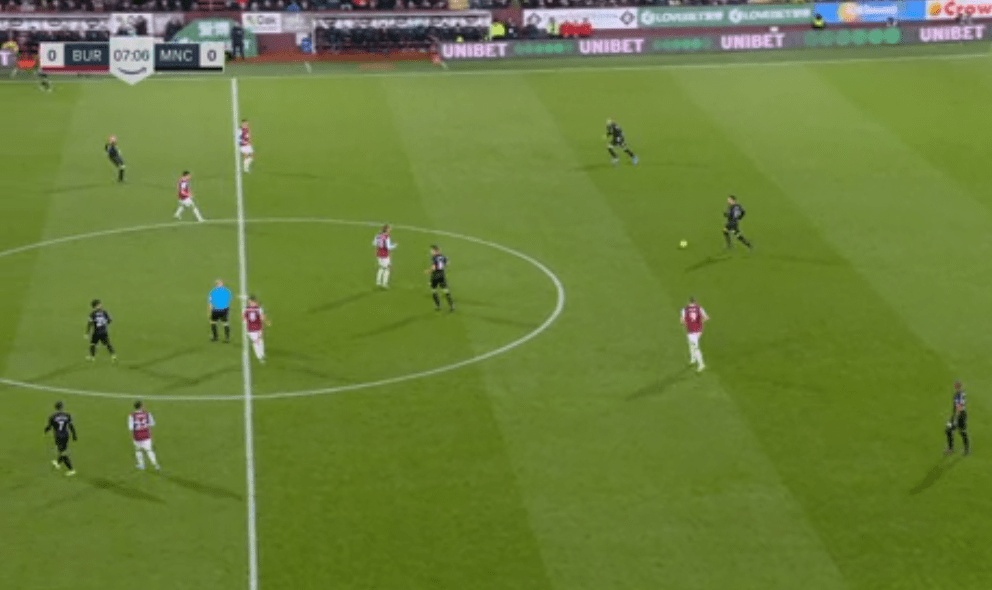
Usually the buildup play City conduct involves the dropping of the number 6 in between the 2 centre backs, which is something Fernandinho has done for the past 2 seasons, but this game saw City deploy another mechanism, instead using Kyle Walker in the build up phase, leaving Rodri free to go forward, as this screenshot shows.
This was important since first and foremost it gave us the coveted numerical superiority to play from our centre backs (+right back in this scenario), past Burnley’s press and into the midfield. It also had ramifications higher up the pitch, and tied into the overall goal of achieving numerical superiority in the central areas of the pitch. Rodri’s movement here is very significant, since it occupies the other Burnley striker and prevents the centre backs from being pressed by 2 players, and allows City to have more men in the middle.
This didn’t just benefit him in terms of play on the ball, but also in the counter pressing contributions he made. He won a lot more duels in this game than usual, as well as making 12 ball recoveries, and I feel this positioning helped him do that. Whilst Rodri is technically skilled and profound on the ball, he doesn’t have mobility in abundance, so not having to worry about the thrusting in between the centre back slot and midfield surely benefitted him.
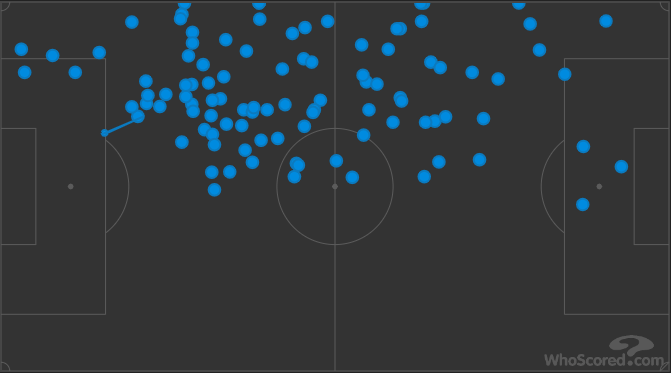
As he was against Newcastle, Kyle Walker was a pretty big part of the City buildup throughout the other areas of the pitch too. In that game, I mentioned how he was deployed as an inverted full back, and this fixture saw him play that role too, with his movement looking to see him join the double pivot once his role in buildup play was concluded.
This touch map really illustrates the central positions Walker was yet again asked to occupy for this City side. He was tucked in very much to the central areas, as he took the title of ‘Inverted Full Back’ to the absolute extreme.
For further visual aid, here’s an in game capture from where Walker has moved on from playing as the 3rd man in the defence, to the holding midfield role. We can see him right next to Rodri, who is the genuine out and out number 6 in the team, and this speaks a lot to the types of demands he was expected to satisfy.
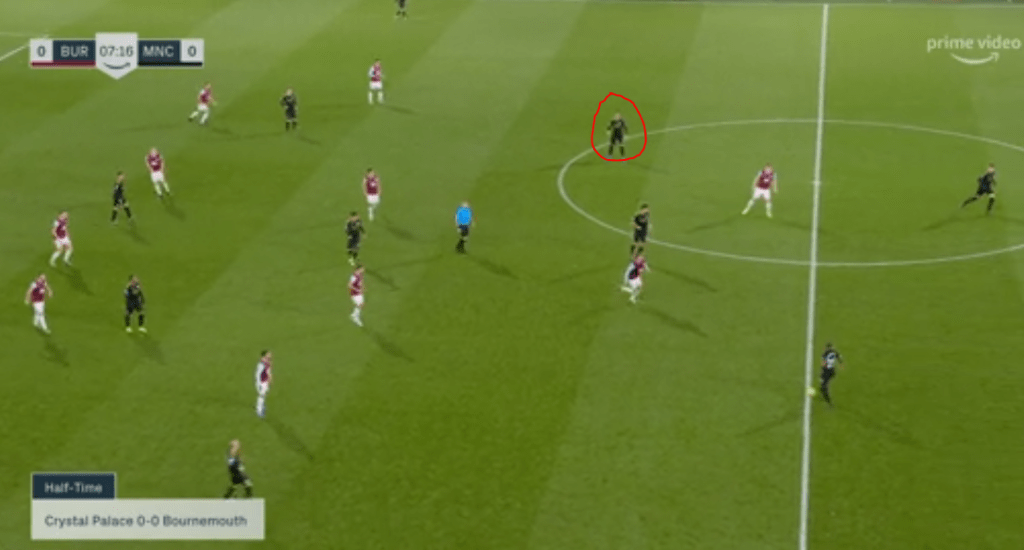
Walker’s presence in this area of the pitch was important for 2 main reasons, that impact both our play in and out of possession. Firstly, when we had the ball he was a big help since it gave us numerical advantage in possession against Burnley’s block. However it also helped us when we lost the ball. After all this is a tactical trait Guardiola developed to try and prevent the rapid counterattacks of the Bundesliga, given that the full back being located here sets the team better to deal with the opposition’s quick paced transitional attacks.
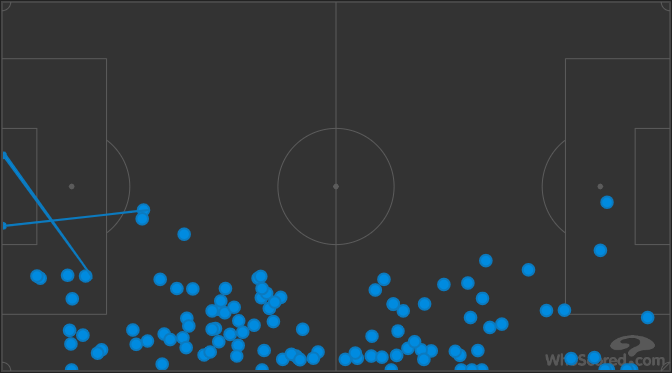
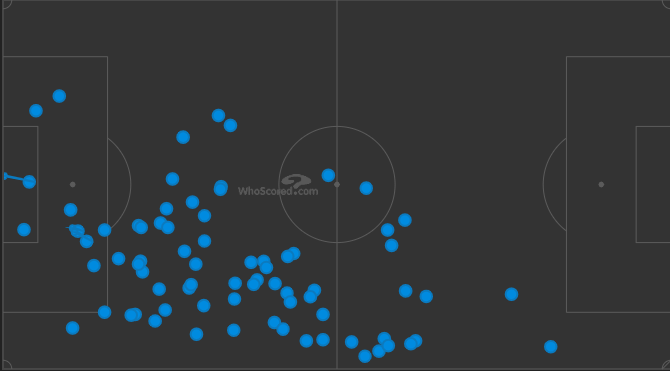
On the opposite side of the fullbacks, Angelino was deployed in a different way. Rather than follow Walker and sing from the songbook of the inverted full back the Spaniard was instructed to evoke the characteristics of a modern full back, playing out wide and acting like more of a winger than his full back colleague.
The touch map Angelino put together during this game speaks to the role he played in City’s set up. The touches he has are a lot denser around the wider areas of the pitch, and congregate more towards Burnley’s defensive 3rd.
One thing that I’ve noticed from analysing quite a lot of Guardiola’s matches is that when the full back goes wide, it has deeper significance to the positioning of the winger. Last week we saw Mendy go out wide, and how in doing so the winger, Raheem Sterling, was allowed to go inside between the Wing Back and centre half in the Newcastle.
His heat map from this game shows that he was clearly more of a half space occupier than an out and out winger who’s job is to take the ball to the byline and cross:
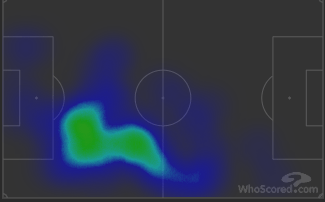
The touch map he produced from this game only speaks to add more evidence to this role, as he recorded the majority of his touches in that ‘inside winger’ position.
Sterling’s assignment to this area of the pitch is also something supports my claim that Guardiola’s priority was overloading the centreal areas and forcing the Burnley defenders to sacrifice their shape and ultimately lose defensive integrity. The fact that Guardiola would place a winger inside, as well as a full back, whilst also ensuring the pivot man could go forward to occupy an extra man in claret and blue, is telling to the strategy City ran with in this game.
One of the more conventional features of the Guardiolan City side that were on display here was the use of the number 8’s. By now I feel any City fan and avid spectator of Pep in charge of City would understand the role of the two number 8’s; occupy half spaces, drop into spaces, occupy positions next to the striker and on the opposition defensive line, and ultimately look to be the special something that can unlock a stubborn and compact defense.
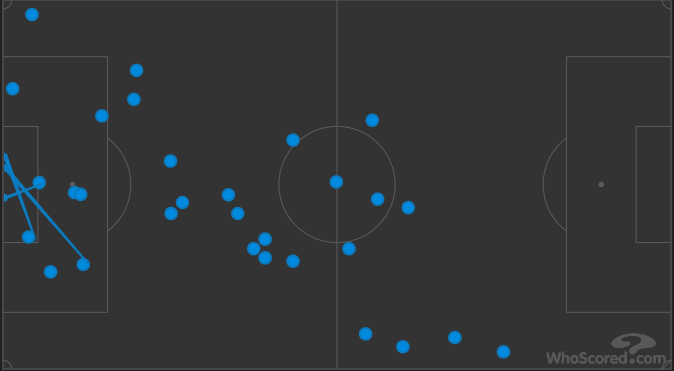
This is the touch map of the two number 8’s, and as daft as it sounds I really can’t think of anything that tactically elaborate to say that wouldn’t be old news to anyone that’s watched us. We have two really good football players playing in this role, and as they should they get tons of touches, and act as our creative sparks.
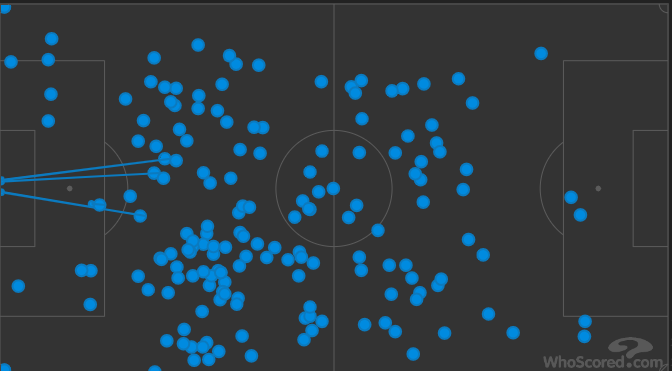
Also, something else that is slightly noteworthy and considers our play in possession v Burnley was the role of Gabriel Jesus. Everyone will talk about his goals of course but he really is naturally suited at playing that false 9 role. His touch map shows that he was dropping deep and collecting the ball, and this is so important in a game where the priority is overloading the centre of the pitch.
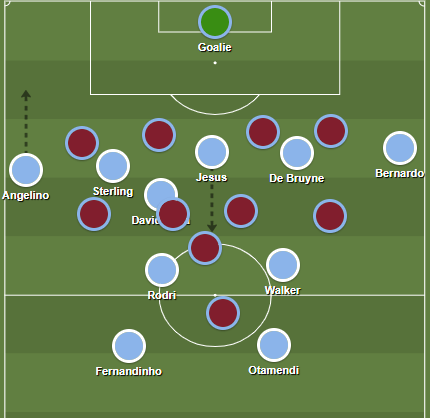
All in all, this is what our possession structure looked like roughly in the Burnley game. Pep Guardiola once referred to formations in football as “nothing but telephone numbers“, and this game really embodies his disregard for the confines of a 4-3-3. Sterling plays inside, Silva and De Bruyne occupy the half spaces up high, Walker plays as a temporary double pivot on the ball, and Angelino goes out wide as the outlet pass. Bernardo Silva’s positioning was sometimes very wide, sometimes an auxiliary half space player, so really he was in a balanced kind of role.
“Formations are nothing more than telephone numbers – Pep Guardiola”
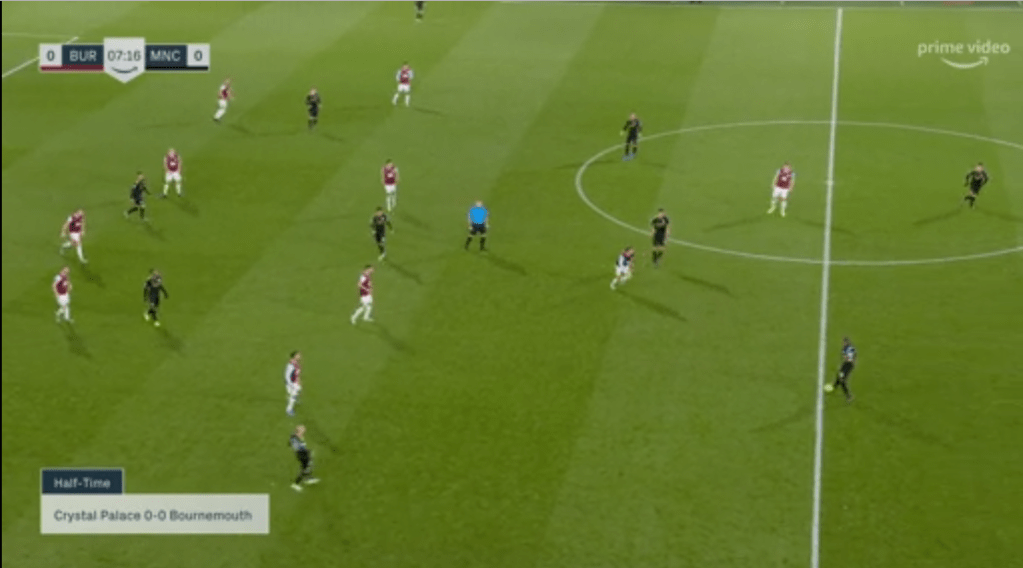
And just for good measure, here’s an in game depiction of the structure I’ve discussed in this post, with all the aforementioned elements; the double pivot formed with Walker & Rodri, the two 8’s playing advanced, Sterling tucked in as an inside winger occupying the Burnley full back, and Angelino making the most of the available space.
Overall this gameplan was an absolute success. We won the game 4-1, in a time when we really needed it, and with this win we got a lot more than 3 points; we welcomed the return of our identity. It hadn’t just been a while since a big win, it had been a while since we saw the team that we’ve watched for the past 2 years dominate domestic football in this country. Perhaps this result is a turning point for the season, a catalyst for the City of old to return before our eyes and to hunt down the leaders of the pack.
We’ll have to see.
For now, we have that team in red to go up against, so let’s focus on them for the time being.

 The Kippax tactician