As City drew 2-2 away at Newcastle and slid further away from Premier League retention, I couldn’t help but feel a sense of footballing deja vu.
There was a retro feel to this fixture, evoked in the way that City dominated the game, created chances, but ultimately ended up dropping points. It felt very much like 2016 City, during Guardiola’s inaugural season, where these characteristics were very common for City fans to see.
However, aside from these obvious frustrations there was a lot to like when it came to our play on the ball, with a number of interesting animations going on throughout the match.
City’s possession play

City lined up in a 4-3-3, but individual players had certain in game movements that would affect the practical shape of the side through the match. Arguably the most noticeable of these movements was that of Kyle Walker, who of course began the game as right back but was regularly seen sitting in the centre of the pitch alongside the pivot Ilkay Gundogan. The use of the inverted full back is nothing new to Guardiola’s tactical repertoire or this City team for that matter, but still the use in this fixture was particularly noticeable. As illustrated by this touch map , Walker was well asserted into central positions.

On the other flank, Guardiola opted for a different approach to the utilisation of Benjamin Mendy. Instead of going inside and occupying central spaces, Mendy opted to play more as a wide lying fullback. Perhaps this role is one that is more accustomed to the modern movement and design of fullbacks, as opposed to the more obscure use of the full back as an auxiliary midfielder which was what Kyle Walker was in this match. Again, the touch map illustrates the deployment of Mendy in this game, much like it did for Kyle Walker.
The methods in which Guardiola decided to use these full backs are important, as it dramatically impacts the other aspects of the possessional play City subscribed to for this game, with various different elements of how we set up being altered due to the positioning and movements of certain players. The use of the fullbacks created something of an asymmetrical structure for this game, with Walker tucked inside and Mendy out wide. Obviously City setup in a 4-3-3, but in reality, the shape they adopted when attacking didn’t exactly feel any of the constraints of a particular formation.
Firstly, by inverting Kyle Walker, Guardiola formed a makeshift double pivot between Gundogan and Walker, and this tied in with both City’s building from the back as well as the play in the final 3rd of the pitch.
The significance of the double pivot to building from the back can be seen in this screenshot, as City’s temporary double pivot combine with the two centre backs to create something of a box/diamond shape. Heading into the fixture there were no believers that Newcastle would look to press high up the pitch, and so they only really had Joelinton engaging the backline in a press. Look at how easily City outnumber him, 4v1, with Gundo/Walker aiding Dinho and Stones in playing the ball out.

Maybe the best way of quantifying City’s progression of the ball from their own 3rd is in numbers, including the 77 & 88 passes that the two central defenders played between themselves.
As the ball got higher up the pitch, Gundogan and Walker proved important too, especially in linking up with the number 8’s. In this area of the pitch Gundogan and Walker stayed in line with one another, playing as if they were 2 holding midfielders, in order to allow the more creative players in David Silva and Kevin De Bruyne to go forward. Newcastle were always going to set up in a 5-4-1, as well as look to prioritise being compact and tough to play through, so City looked to do their best to outnumber them, or at least get some modicum of numerical equality. This wouldn’t happen if it was the 3 man midfield vs Newcastle 4, so Pep was forced to adjust.
This screenshot highlights exactly what I mean; the box midfield with Walker inverted and the two number 8’s pushed ahead, as City looked to almost engulf the Newcastle midfield in an effort to find gaps (also please forgive the annotation quality, I’m a writer not an artist).

All in all, you have to say this part of City’s gameplan worked. De Bruyne had a great game, providing a goal that really should have won us the game, as well as a multitude of key chances including a Raheem Sterling chance that should have been converted. As for the other 8, David Silva looked better than he has in recent weeks, and also managed to get an assist.
Not to mention that it saw the two number 8’s get plenty of touches on the ball. De Bruyne recorded 113 touches this match, with Silva having 72.
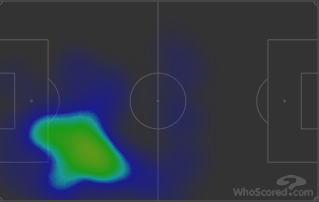
As if to keep in the theme of how important the fullbacks positioning was in this game, Ben Mendy’s was also of great significance to how we attacked Newcastle. Of course Mendy went wide while Walker inverted, and Mendy’s presence as a wide playing full back had implications upon Raheem Sterling. Since Mendy was giving City width on that side, Sterling was given the license to play more upon the back 3 of Newcastle, particularly in between the wing back and centre half on that side. This role allowed him to operate almost as if he were a 2nd striker, and then Gabriel Jesus could play like he usually does when he starts up top.
Ultimately I feel that the goal of City’s possessional play, and the way they would go about trying to unlock a tight and compact Newcastle defensive unit, was to overload the left hand side and switch play to the right with pace.
This is further reinforced when you look at how wide Riyad Mahrez played on that right hand side, as he was instructed to adopt the guise of the outlet ball once City achieved the overload and wished to switch the side of attack. This article from Jack Gaughan even mentioned how “Riyad Mahrez was screamed at to stay wide”, further reiterating the point of Mahrez’s role as the outlet.
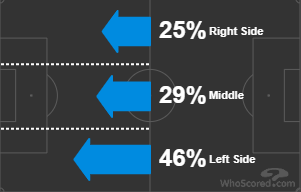
If you need any more confirmation on the priority of City’ attack being to overload and switch, then maybe it can be found in the fact that 46% of City’s attacking moves were invested on that left side.
Or, that literally as soon as the game began the immediate move was to overload one side, go through the double pivot, and look to play in Riyad.
The end product of CIty’s possession gameplan can be seen here, with all mechanisms that have been discussed evident and on display. We see the box midfield that has been formed by the inversion of Kyle Walker, along with Gundogan and the two more advanced 8’s. Mendy is also playing out wide closer to the touchline than his right back colleague, with Sterling being able to tuck in a little bit more to play as a supporting striker.

All in all, I feel that this was a good offensive gameplan from Guardiola. City were able to create an awful lot of chances against a team that was hellbent on defending, and there was a clear and cohesive strategy throughout the 90 minutes.
We created chances throughout this game and dominated possession with 77% possession. Defensively we were a little poor but the XG map definitely speaks in our favour, and I feel the thing that most let us down was the conversion of chances.
However the main flaw to his strategy in my opinion was the deployment of Benjamin Mendy. A few years ago in his Monaco days Mendy was a fine athlete, able to function as a winger’s best friend and opposing full backs worst nightmare, but since he’s sustained so many injuries at City he’s lost that dynamism he once had. Because of this I think throwing him in high up the pitch was a little naive, given that once possession was lost he had an awful lot of ground to cover, not to mention that he was left out of position.
Newcastle spent a lot of their offensive moves targeting that side that Mendy was pushed up on, because they knew that they would have more space on that side than on the one where Walker was pretty much living in the vertical spaces. WhoScored.Com tells us that in this match they spent 45% of their attacks on that side, which is a big outlay.

Anyone who watched that game could tell you that Mendy was really quite awful in it, and I don’t think he’s ready to be a high lying fullback who has to sprint back. He’s fresh from 2 years worth of being off, and I’m not saying Pep is entirely at fault here but it can’t have helped Mendy who’s trying to get back to 100%.
In my opinion, setting Kyle Walker up as in the wide playing up and down modern day full/wing back would have been a better move for us to make. This would allow a Walker to use his speed that he still has to fill that role better, whilst Mendy would have been a little more protected as he aims to find his feet.
All in all, a logical tactical setup hardly erases a disappointing result and a frustrating season.
But, it’s a decent way to distract yourself from it.
We go on to Burnley.

 The Kippax tactician